AI patient scheduling uses data-driven automation to adjust availability, match patients with appropriate providers, and respond to changes in real time. Traditional healthcare scheduling relies on staff and preset templates. Gravity, Innovaccer’s Agentic AI Access Center, brings AI scheduling to patient access with 24/7 agents across voice, SMS, and chat. Before switching, healthcare organizations should assess integration, data quality, privacy and security, patient accessibility, staff workflows, and how they will measure results.
AI patient scheduling vs traditional healthcare scheduling: traditional methods
The Inefficiency Trap
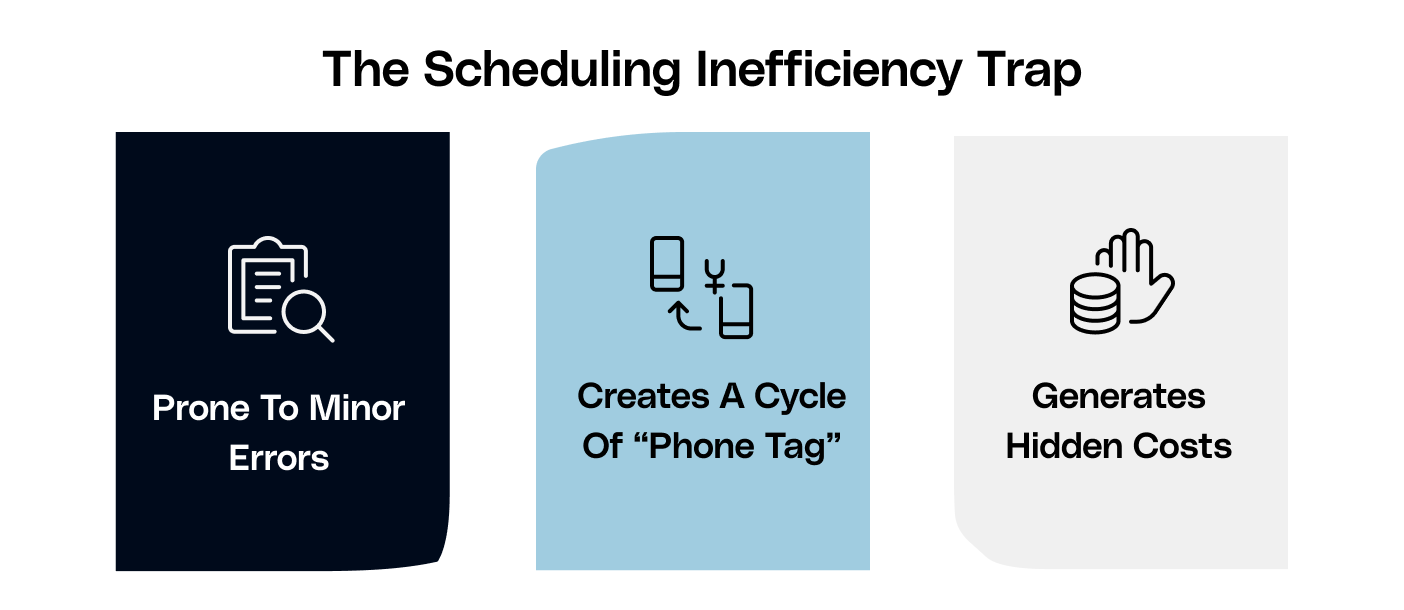
Traditional scheduling depends on staff making manual adjustments, which creates delays and inefficiency.
- Uneven provider workloads. Fixed slots mean physicians can see several complex patients back to back, then face idle time. Every patient gets the same brief slot regardless of need, which pushes clinicians to rush and adds to burnout.
- Long waits for care. Patients waiting to be seen with concerning symptoms carry real anxiety, and many give up on the call before booking is confirmed.
- Limited options. Business-hours phone scheduling disproportionately affects people with logistical constraints, such as single parents, workers without paid time off, and those who depend on public transportation. Innovaccer reports that 20-30% of scheduling opportunities happen after hours, when most access centers are closed.
Benefits of AI scheduling in healthcare
AI scheduling gives patients 24/7 self-scheduling through voice, SMS, and chat. It also optimizes provider schedules, prioritizes urgent cases, and fills cancellations quickly.
Gravity’s AI agents handle routine scheduling, eligibility checks, and FAQs, and escalate complex needs to staff who work with an AI copilot. Innovaccer reports that health systems using the platform have seen a 30%+ increase in appointment and referral conversions and that over 70% of interactions are now automated, based on internal assessments.
At Franciscan Health, Innovaccer’s AI access solution delivered $19.2M in annualized value, a 30% increase in patient volumes, and 128,000 additional primary care appointments.
AI also personalizes appointments. Gravity applies provider matching protocols, so patients can be matched based on specialty, language, past relationships, and communication preferences.
Also Read: How AI Tackles Physician Burnout in Healthcare
AI patient scheduling vs traditional healthcare scheduling: side-by-side comparison
| Traditional | AI-driven |
|---|---|
| Business-hours availability | 24/7 self-scheduling across voice, SMS, and chat |
| Fixed time slots regardless of need | Provider schedules optimized around case complexity |
| Manual waitlist management | Cancellations filled quickly and automatically |
| Generic provider assignment | Matching based on specialization, language, and preference |
Benefits of AI scheduling in healthcare: access and equity
AI scheduling can help close access gaps by giving patients more ways to reach care. Gravity’s AI agents support 10+ languages, including Spanish, Portuguese, Chinese, Hindi, and more. Patients who cannot or prefer not to use digital tools should still have a clear route to a person, and accessibility features should be tested for patients with disabilities.
Impact of AI on healthcare appointment management
AI scheduling can lower administrative costs by automating routine work, which lets staff focus on patients who need human support. Franciscan Health’s $19.2M in annualized value shows what this can look like at scale. Balanced schedules also give physicians appropriate time between complex cases and documentation, which supports both clinician well-being and patient experience.
Time to value matters too. Innovaccer states that some use cases, such as FAQs, can go live in 2 to 4 weeks, followed by scheduling and more complex use cases.
Challenges of switching to AI patient scheduling in healthcare
Implementation challenges include integration with existing systems, inconsistent scheduling data, workflow redesign, staff adoption, privacy and security governance, patient accessibility, and ongoing performance monitoring.
Start by identifying what works well in your current scheduling process and should be preserved. Compare appointment automation with your manual workflows, then add AI where it addresses real pain points. A phased rollout lets you test workflows, safety, equity, and operational effects before broader deployment. Gravity writes appointments back to your EHR, so staff do not have to learn a parallel scheduling interface.
FAQs
What is artificial intelligence scheduling in healthcare?
Artificial intelligence scheduling is the use of automated, data-driven systems to manage appointment availability, match patients with the right provider, fill cancellations, and adjust schedules in real time, replacing manual, template-based processes. Deployment still requires reliable scheduling data and oversight of the resulting workflows.
How does AI patient scheduling compare with traditional healthcare scheduling?
AI patient scheduling adjusts availability, matches patients to providers, and responds to cancellations using data-driven automation. Traditional scheduling generally depends on preset slots and staff making changes. Compare the two against your appointment types, patient access needs, integration requirements, and the amount of staff review each workflow requires.
How does AI scheduling reduce no-shows?
AI scheduling can identify appointments at higher risk of being missed and trigger personalized outreach and reminders instead of one generic message for everyone. Gravity’s AI agents conduct outreach, book appointments, and deliver timely reminders. Validate the outreach rules and observed effect in your own setting.
Is AI scheduling secure for patient data?
Security depends on the vendor’s design and your configuration. Innovaccer states that its access center solution is HIPAA-compliant and HITRUST-certified. As with any vendor, confirm controls, access, audit trails, and BAA terms against your organization’s requirements before deployment.
Does AI scheduling replace call center staff?
No. It is designed to automate routine scheduling volume so staff can focus on complex cases and patients who need human help. Gravity includes built-in escalation logic for warm transfers to live agents. Define which requests need escalation and how patients can always reach a person.
What are the challenges of implementing AI scheduling in healthcare?
The main challenges are integrating with existing systems, improving data quality, redesigning workflows, defining governance, protecting patient information, maintaining accessible non-digital options, training staff, and monitoring performance. A phased rollout should preserve effective processes and test safety, equity, and operational effects before expansion.
What factors should we consider before adopting AI scheduling in healthcare?
Consider whether the system integrates with your scheduling and clinical workflows, whether appointment data is reliable, and how privacy, security, and accessibility will be protected. Define staff escalation paths and patient alternatives, then set measures for access, scheduling performance, safety, equity, costs, and adoption before a phased rollout.
Experience this transformative approach firsthand by scheduling a demo of Innovaccer’s solutions today.